

.svg)
Content Distribution Strategy: Get More From Every Post You Publish | ClusterMagic
Most content teams spend ninety percent of their time creating and ten percent distributing. The result is excellent content that fewer than one percent of their target audience ever reads. A content distribution strategy flips that ratio by treating every published piece as the start of a multi-channel campaign rather than a finished product that lives on your blog and nowhere else.
This guide breaks down how to build a distribution system that works across owned, earned, and paid channels without requiring a massive team or budget. The goal is simple: make sure the content you already produce reaches the people it was designed for.
What a Content Distribution Strategy Actually Covers
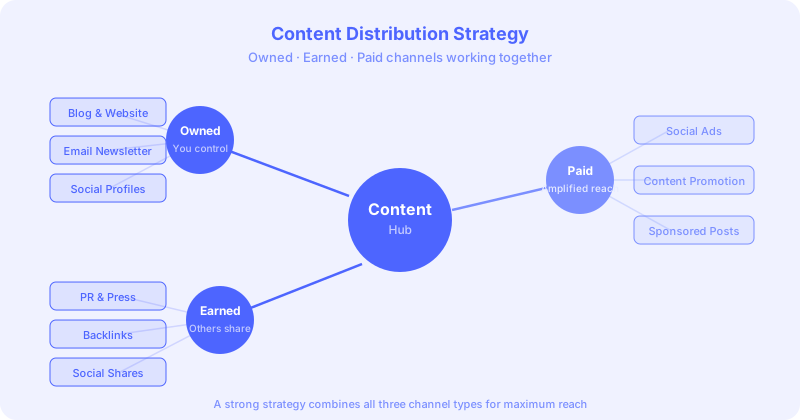
A content distribution strategy is the plan you use to get content in front of your audience across every available channel. It answers three questions: where does your audience spend time, what format works best on each channel, and in what sequence do you activate those channels after publishing?
Every distribution channel falls into one of three categories. Owned channels are platforms you control directly: your email list, website, and social profiles. Earned channels are organic reach you have built through relationships and reputation: media mentions, guest posts, community shares, and organic search. Paid channels are amplification you purchase: sponsored social posts, content syndication networks, and paid newsletter placements.
A mature distribution strategy activates all three in a coordinated sequence rather than treating them as separate efforts. Publish on your owned channels first. Use earned distribution to amplify what performs well. Deploy paid only when you have evidence a piece resonates, so you are spending budget on proven content rather than guessing.
Mapping Your Channels Before You Distribute
The most common distribution mistake is spreading thin across too many channels. A focused strategy on three to five channels where your audience is most active outperforms surface-level presence on ten. Before building your distribution plan, audit where your current traffic and engagement actually come from.
Pull your analytics and identify which channels are sending qualified traffic, not just volume. For most B2B content teams, the highest-leverage owned channels are email newsletters and LinkedIn. For consumer brands, Instagram, YouTube, and TikTok often dominate. The right channel mix depends on your audience, not on what is currently trendy.
Once you have your core channels identified, map a specific action for each channel against each content type you produce. A long-form blog post might generate three LinkedIn posts, one email newsletter section, two short-form Twitter threads, and a repurposed segment for a future video. Document these sequences in a simple template so distribution becomes a repeatable process rather than an ad hoc decision.
Repurposing: The Core Engine of Efficient Distribution
Repurposing is not copying and pasting your blog post into different platforms. It is extracting the most valuable ideas from a piece and packaging them in the format that works on each channel. A 1,800-word post on organic traffic growth contains enough material for a week of social content, a newsletter deep-dive, and a short explainer video script.
A documented content repurposing workflow makes this process repeatable across your team. One core asset should turn into at least five channel-specific formats. Here is a practical repurposing sequence for a single blog post:
- Extract the three most counterintuitive points for a LinkedIn carousel
- Pull the key stat or finding for a standalone social post with a link
- Write a 150-word email teaser that links to the full post
- Turn the H2 structure into a short-form video outline
- Submit the post for content syndication on relevant platforms
This approach multiplies the reach of each piece without requiring new research or a new creative brief. The content already exists; distribution packaging is the only additional work.
Timing and Sequencing Your Distribution
Distribution timing is not about following generic best-practice schedules. Your own analytics data on when your specific audience reads, shares, and clicks will outperform any industry average. First-party timing data beats published benchmarks because your audience behaves differently from the aggregate.
A typical distribution sequence for a new blog post might look like this: publish the post and submit it to your sitemap on day one, send the email newsletter teaser on day two, publish the LinkedIn carousel on day three, post the short social snippet on day five, and submit for syndication at the end of week one. Staggering the distribution prevents your audience from seeing the same message everywhere on the same day, and it gives you multiple bites at the algorithm on each platform.
For evergreen content, build a re-distribution calendar. A post published in January should be redistributed in April, August, and the following January with updated framing. Evergreen pieces have a longer shelf life than most teams take advantage of. Treating every post as a single-use asset wastes the majority of its value.
Measuring Distribution Performance
Most content teams track creation metrics (posts published, words written) but not distribution metrics (reach per post, channel-specific click-through, downstream conversions per channel). Without distribution measurement, you cannot tell which channels are worth the effort.
The metrics that matter for distribution are reach (how many unique people saw the content on each channel), engagement quality (clicks, shares, replies rather than passive impressions), and downstream conversions (demo requests, newsletter sign-ups, or downloads that originated from a specific distribution channel). Proven audience engagement tactics help you optimize what happens after distribution gets eyes on the page. Set up UTM parameters on every distributed link so you can trace traffic back to the specific channel and even the specific distribution format.
Track these metrics at the post level and the channel level. At the post level, you learn which content resonates enough to invest paid amplification behind. At the channel level, you learn where to concentrate future distribution effort and where to cut. Most teams discover that two or three channels drive the overwhelming majority of their distribution-sourced conversions.
Connecting Distribution to Your Content Architecture
Distribution works best when it is tied to a clear content architecture. When you know which posts belong to which clusters, you can distribute in ways that strengthen internal linking and topical authority simultaneously. Every distribution touchpoint is an opportunity to route your audience deeper into your content ecosystem.
For example, a LinkedIn post distributing a new piece on content distribution strategy should link to the canonical blog post, and that post should include internal links to your blog content strategy and scale content production guides. Each distributed piece pulls readers into a connected network of content rather than depositing them on a single page with nowhere to go next.
ClusterMagic's cluster mapping makes this easier by showing you exactly which posts belong together and which internal links are missing. When you distribute with cluster awareness, each piece of distributed content builds authority for the whole cluster rather than just the individual post.
Building Distribution Into Your Production Workflow
Distribution should not be an afterthought that happens after a post goes live. The best teams build distribution planning into the content brief. Before a writer starts a post, the brief should specify which channels it will be distributed to, what the repurposing formats are, and when the distribution sequence kicks off.
This pre-distribution planning changes how writers approach content. Knowing a post will become a LinkedIn carousel means writing sections that can stand alone as concise, quotable ideas. Knowing a section will be pulled for an email teaser means making the opening of each H2 strong enough to work out of context.
A distribution-first workflow removes the scramble that happens when a post goes live and no one has planned how to promote it. It also ensures that your highest-effort content gets the widest reach rather than quietly accumulating views only from organic search.
If you want to see how ClusterMagic's content architecture tools connect to a smarter distribution workflow, book a walkthrough and we will map out a distribution sequence built around your content clusters.
Further reading:
Recommended Posts




.svg)