

.svg)
Content Strategy for SaaS Growth: The Playbook That Compounds | ClusterMagic

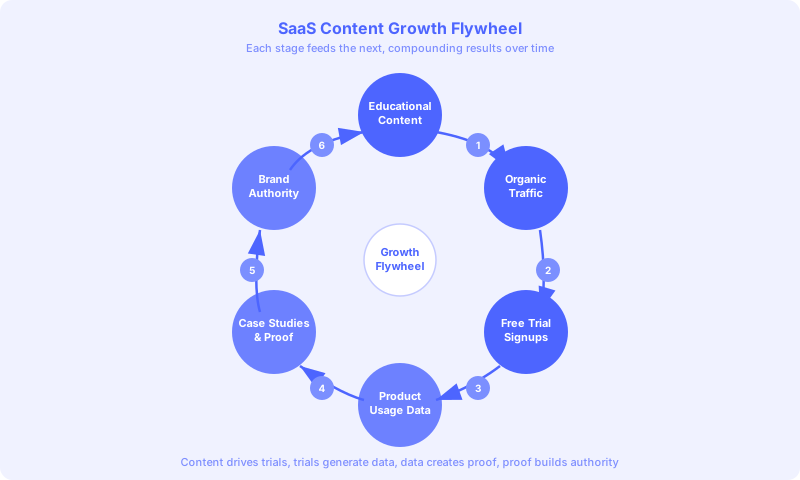
B2B SaaS SEO averages 702% ROI over a three-year window. That number sounds like marketing copy, but it reflects something real: content compounds in a way that paid advertising does not. A well-built content strategy for SaaS growth creates an asset that generates leads while you sleep, shortens sales cycles by educating buyers before they reach your sales team, and reduces churn by helping customers succeed with your product after they buy.
The catch is that most SaaS content programs never reach that compounding phase because they skip the foundational architecture. They publish inconsistently, target the wrong keywords, or create content that speaks to no one in particular. This playbook covers the structure that makes SaaS content compound rather than stall.
Why Generic SaaS Content No Longer Works
The content landscape for SaaS changed significantly between 2020 and 2026. The playbook of publishing generic educational posts ("what is X," "benefits of Y") worked when Google rewarded volume and informational content. It works less well now because Google AI Overviews answer generic informational queries directly in the search results, reducing click-through to the organic results below.
SaaS companies still investing in generic awareness content are writing for an AI summary box rather than for a reader. The posts that capture clicks in 2026 are those that require depth, specificity, and real-world experience that a summary cannot replace: comparison guides, use-case walkthroughs, honest evaluation content, and highly specific how-to guides for your exact buyer.
The second shift is audience sophistication. SaaS buyers in 2026 research more thoroughly and trust hard-sell content less. Comparison guides that acknowledge your product's weaknesses convert better than those that do not, because readers know they are being sold to and respond to transparency. Your content strategy needs to earn trust, not just rank.
Define Your ICP Before You Plan a Single Post
Every SaaS content strategy that works starts with an honest, specific definition of the ideal customer profile (ICP). Not a demographic profile, but a behavioral one: what problem are they actively experiencing, what do they search when they look for a solution, and what objections do they raise before buying?
In B2B SaaS, you are often writing for two audiences simultaneously: the user who will work with your product daily and the buyer who approves the purchase. These two audiences need different content. The user wants to know if the product will make their job easier and faster. The buyer wants to know if the investment is defensible and whether the vendor is reliable. A content strategy that only addresses one of these audiences leaves money on the table.
Map each ICP to the specific search queries they use at each stage of awareness. A user-stage query might be "how to automate content briefs"; a buyer-stage query might be "content marketing platform vs. hiring content team." Both belong in your keyword strategy. Both need content written with their specific decision context in mind.
Building Content Pillars Around Problems, Not Features
SaaS companies often structure their content around their product's features. This makes sense from an internal perspective but fails from a search perspective, because buyers do not search for your feature names. They search for the problems those features solve.
A project management SaaS should not build a content pillar around "task dependencies" because nobody searches that phrase in relation to a buying decision. They should build a pillar around "remote team productivity" or "engineering sprint planning" because those are the problems the product solves and the language buyers use. Content pillars should map to customer problems, not product features.
For most SaaS companies, three to five content pillars is the right scope. Each pillar covers a core problem your ICP experiences, with a cluster of supporting posts targeting long-tail keywords that capture specific facets of that problem. A well-structured content clusters architecture means every supporting post strengthens the authority of the pillar page and the whole cluster benefits each time you publish a new supporting piece.
Connect each pillar back to a product use case so that editorial decisions also serve sales enablement. When your content pillar maps directly to a sales motion, every post in the cluster becomes a potential nurture asset.
Funnel-Stage Content: Mapping Posts to Buying Stages
A SaaS content program that only publishes top-of-funnel educational content generates awareness but not pipeline. A program that only publishes bottom-of-funnel comparison and review content skips the buyers who are not ready yet. Full-funnel coverage captures buyers at every stage and moves them through the decision process.
Top-of-funnel content targets problem-aware buyers who have not yet committed to a solution category. These posts answer "how do I solve X" questions without assuming the reader knows what kind of tool they need. They generate organic traffic volume and introduce your brand to buyers early in their research.
Middle-of-funnel content targets solution-aware buyers who are evaluating their options. These posts compare approaches, help buyers articulate requirements, and position your product's perspective on the problem. This is where saas content marketing content earns the most trust, because buyers at this stage are reading carefully and skeptically.
Bottom-of-funnel content targets product-aware buyers who are comparing specific vendors. These posts include comparisons against competitors by name, detailed use-case walkthroughs, ROI calculators, and customer success stories. This content closes gaps that keep qualified prospects from booking a demo.
The Lifecycle Content Layer Most SaaS Companies Skip
Acquisition content gets all the attention in SaaS content strategy, but lifecycle content often produces higher ROI per post because it serves customers who have already converted. Lifecycle content includes onboarding guides, feature education posts, troubleshooting articles, and expansion use case documentation.
Lifecycle content improves product adoption by helping customers discover features they would otherwise miss. It reduces churn by answering the questions customers have when they hit friction. It supports expansion revenue by showing existing customers how to use your product for adjacent problems they have not connected to your platform yet.
This content also benefits your SEO because it generates organic search traffic from existing customers researching how to use your product, from potential customers evaluating your depth of documentation, and from users of competing products who discover your educational content and compare it to what their current vendor offers. Connect your lifecycle content program to your content marketing for saas playbook to ensure onboarding and retention content gets the same strategic attention as acquisition content.
Building Your SaaS Content Calendar Around Cluster Gaps
Most SaaS content calendars are built around brainstormed ideas or editorial whims. A strategy-driven calendar is built around the gaps in your cluster architecture: the keywords your pillar clusters need covered, the funnel stages that are underserved, and the competitors' content you need to match or surpass.
Start each quarter by auditing your cluster coverage. For each pillar, list the top twenty to thirty keywords in that cluster and identify which ones have existing content targeting them and which do not. The gaps become your production priorities for the quarter. This approach means every post you publish fills a documented need rather than adding a redundant treatment of a topic you have already covered.
Pair the cluster gap audit with a competitor content audit. Identify the posts driving the most traffic to your direct competitors and assess whether you have comparable or better coverage. A structured content gap analysis reveals the keyword-level gaps where competitors are capturing intent you are not. These gaps represent the highest-priority content investments because your competitors have already validated that searchers are looking for this content.
Measuring SaaS Content Performance Against Revenue, Not Traffic
Traffic is a leading indicator. Revenue impact is the metric that justifies content investment to CFOs and growth leaders. Build your measurement system to trace the line from content to pipeline as precisely as your attribution model allows.
Practical SaaS content metrics that connect to revenue:
- Content-attributed MQLs: leads whose first touch or last touch was a piece of content
- Content-influenced pipeline: deals where prospects engaged with content during the sales cycle
- Average deal velocity for content-influenced vs. non-content-influenced deals (content-educated buyers often close faster)
- Churn rate for customers who engaged with lifecycle content vs. those who did not
Track content marketing ROI at the pillar level, not just the individual post level. The content strategy ROI measurement guide covers how to connect pillar-level metrics to the financial outcomes that justify continued investment. Some posts in a cluster are low traffic but drive high-intent leads; others drive volume but low conversion. The pillar-level view shows whether your cluster architecture is generating business outcomes, which is the only metric that justifies continued investment.
Review content performance quarterly at the strategic level and monthly at the operational level. Quarterly reviews ask whether your content strategy is advancing business goals. Monthly reviews track whether your production cadence, keyword coverage, and distribution are on track to produce those results.
Scaling SaaS Content Without Losing Quality
SaaS content programs that scale successfully do so through systems, not just headcount. Standardized brief formats, clear style guidelines, and a repeatable review process let you produce more without the quality degrading as volume increases. The content performance metrics guide covers which signals to track at scale so you can catch quality drops before they show up in traffic data.
Build content templates for each recurring content type: comparison pages follow a consistent structure, feature education posts follow a consistent format, and pillar pages are built to a defined depth standard. Templates remove ambiguity for writers and reviewers, which speeds up production and makes quality more consistent across contributors.
ClusterMagic handles the cluster mapping and gap identification that drives the strategic layer of this system. Instead of manually auditing your keyword coverage and competitor gaps, you see a real-time view of your topic architecture and the posts you need to publish next. Book a walkthrough to see how the cluster architecture maps to your SaaS product's specific problem space.
Further reading:
Recommended Posts





.svg)