

.svg)
Ecommerce Content Marketing Strategy: Build One That Works | ClusterMagic

Why Most Ecommerce Content Strategies Fall Apart
The word "strategy" gets applied to almost every content decision, but most ecommerce brands do not actually have one. They have a publication schedule and a list of topics someone thought sounded relevant. That is not strategy. That is organized guessing.
A real ecommerce content marketing strategy starts with a clear objective, maps keywords to buyer intent, organizes content into clusters that build topical authority, and defines how success gets measured. Without those four elements, content production is expensive and its results are unpredictable.
This post walks through how to build a strategy that is grounded in search data, structured around how buyers actually shop, and scalable beyond what a single writer can manage.
Define Your Content Objective Before Anything Else
Content can serve multiple business goals: driving new organic traffic, converting visitors who found you through paid ads, retaining existing customers, or building brand recognition in a category. Each of these goals leads to a different content plan.
For most ecommerce brands, the highest-leverage objective is organic search acquisition. Paid traffic stops the moment the budget is cut. Organic traffic from well-ranked content compounds over time and keeps delivering after the investment is made.
If your objective is organic acquisition, your strategy needs to prioritize keywords with search demand, create content matched to buyer intent, and build topical authority through coverage depth. The ecommerce seo organic traffic approach requires patience but builds an asset that appreciates.
If your objective is retention or lifecycle marketing, the strategy looks different: product education, use-case content, and email-driven distribution matter more than rankings.
Clarifying the primary objective before doing any keyword research or content planning prevents the common mistake of mixing incompatible goals into a single content program that optimizes for nothing.
Map Content to the Three Stages of the Buyer Journey
Ecommerce buyers move through a predictable journey: they recognize a need, research their options, and decide what to buy. Your content strategy needs to address all three stages, not just the ones your team finds easiest to write.
Top-of-funnel content targets buyers in the awareness stage. These buyers are searching informational terms: "how to choose a hiking pack," "what is a standing desk converter," "differences between cold brew and iced coffee." This content builds brand exposure and earns search traffic from buyers who are not yet ready to purchase.
Middle-of-funnel content targets buyers evaluating options. These buyers search comparative terms: "best hiking packs for weekend trips," "standing desk vs adjustable desk converter," "best cold brew makers 2026." This is often the highest-ROI content type for ecommerce because the buyer has purchase intent and is looking for guidance.
Bottom-of-funnel content targets buyers close to deciding. These buyers search branded terms, review queries, and product-specific questions: "[brand] reviews," "is [product] worth it," "[product name] vs [product name]." This content reduces friction and owns the final moments before a buyer converts.
A strategy that only publishes top-of-funnel informational content generates traffic but weak revenue attribution. A strategy balanced across all three stages converts organic visitors into buyers.
Build Your Keyword Cluster Map
The structural foundation of any effective ecommerce content strategy is a keyword cluster map. This is a visual or documented grouping of related keywords organized around topic areas your brand wants to rank for.
Cluster mapping works because search engines evaluate topical authority, not just individual page rankings. A site that covers a subject comprehensively earns better rankings for competitive terms than a site that publishes one strong page in an otherwise thin content landscape.
To build a cluster map for ecommerce:
Start with your core product categories. Each category becomes a potential topic cluster. A store selling kitchen equipment might build clusters around coffee, cookware, kitchen storage, and food prep.
Within each cluster, identify the pillar keyword (the broad, high-volume term like "coffee makers") and the cluster keywords (more specific, lower-volume terms like "best pour over coffee makers," "how to clean a coffee maker," "drip vs pour over coffee").
Then audit what content you already have against this map. Most ecommerce brands find significant gaps: their product pages cover some categories but they have no informational content supporting them, or they have scattered blog posts that do not link together or reinforce topical authority.
ClusterMagic automates this mapping process, pulling in your existing URLs and keyword data to show which clusters are well-covered and which are thin. The visual output is a direct input to your content calendar. If you want to understand how topical authority translates into ranking power, that post covers the mechanics in detail.
Choose Your Content Formats Intentionally
Not every format works equally well for ecommerce SEO, and producing video, podcasts, and social content alongside written content requires resources most ecommerce teams do not have. The answer is not to do everything. It is to do the formats that drive ranking and revenue, and layer in others as capacity allows.
Long-form written guides are the workhorse of ecommerce content strategy. Buying guides, category explainers, and comparison posts consistently rank for high-intent keywords and drive measurable organic traffic. According to Brevo's analysis of ecommerce content marketing, brands that publish consistent long-form content outperform those that publish shorter, more frequent pieces for competitive ecommerce keywords.
Product-focused FAQ content captures long-tail queries and reduces pre-purchase anxiety. Buyers who are almost ready to convert often search very specific questions. A page that answers ten common questions about a product can rank for dozens of long-tail terms simultaneously.
Understanding why SEO matters for ecommerce helps justify the investment in these content types to stakeholders. Comparison and alternatives content captures buyers who are evaluating you against competitors. This format requires honesty, acknowledging what your product does not do well, because buyers who reach this content are already doing their own comparison and will notice if your post is one-sided.
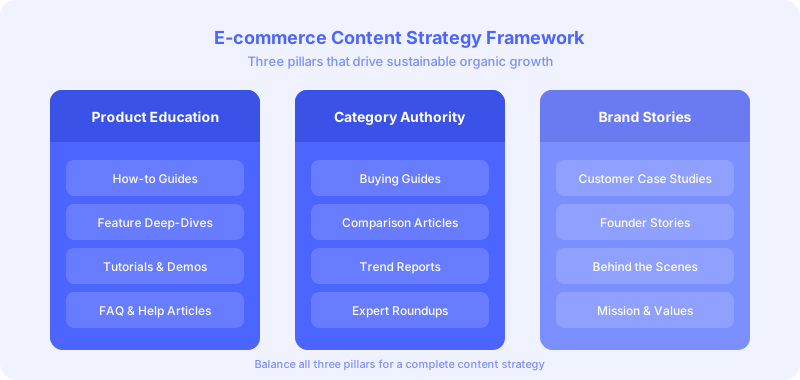
The right format mix for an ecommerce brand investing in seo content strategy is usually 60% buying guides and comparisons, 30% informational content, and 10% product-adjacent or brand content.
Develop a Production Workflow That Stays Consistent
The biggest execution risk in ecommerce content marketing is inconsistency. Publishing six posts in January and zero in March does not build topical authority. Search engines and audiences reward consistency, not bursts.
A sustainable production workflow defines roles, timelines, and quality standards before production starts. For small teams, this typically means one content manager who handles keyword research and briefs, one writer (internal or external), and one person responsible for publishing and internal linking.
The brief is the most important document in the workflow. A strong brief includes the target keyword, search intent summary, recommended post structure, internal links to include, external sources to reference, and the specific questions the post needs to answer. A writer working from a strong brief produces better content faster than a writer given a topic and a word count.
For ecommerce brands working with external writers, the brief also needs product context. A writer who does not understand your product category will produce generic content that sounds like it could come from any competitor. Category-specific details, brand voice notes, and example posts make a significant difference in output quality.
Tracking production in a simple project management tool, even a spreadsheet, prevents posts from getting stuck in draft indefinitely and gives you a clear view of what is scheduled versus what has been published.
Measure What Connects to Revenue
Content marketing ROI is measurable, but only if you set up the right tracking before you start publishing. The mistake most ecommerce brands make is measuring content with vanity metrics that do not connect to business outcomes.
The metrics that matter for an ecommerce content strategy:
Organic traffic to content pages is the leading indicator. Track this as a separate segment from your product and category page traffic so you can see whether content is growing its own audience.
Keyword position movement for target cluster terms shows whether your topical authority is building. Track your position for the pillar keyword and the three to five most important cluster keywords in each topic area.
Assisted conversion rate measures how often a content page appeared in the buyer journey before a purchase. This is the metric that answers "is our content generating revenue?" and it is available in Google Analytics under multi-channel funnels or in GA4 as an assisted conversion.
Pages per session and return visitor rate for content readers indicate whether your content is building an audience or just capturing one-time search traffic. Buyers who read multiple posts and return to your site are developing a relationship with your brand.
A useful content marketing ROI framework tracks these metrics monthly and ties them to revenue so you can make the case for ongoing investment.
The Role of AI in Ecommerce Content Strategy
AI tools have changed the economics of ecommerce content production significantly. Research that used to take hours takes minutes. First drafts can be generated faster. Keyword clustering and gap analysis that previously required manual spreadsheet work can be automated.
But AI alone does not produce good ecommerce content. The brands winning with AI-assisted content in 2026 are the ones using it to accelerate a well-defined strategy, not replace strategic thinking. According to STRYDE's 2026 planning guide, brands using AI to build content workflows are seeing compounding gains, but only when the underlying strategy is sound.
The most effective use of AI in ecommerce content is in the research and structure phase: using it to identify keyword clusters, generate post outlines, find common buyer questions, and draft meta descriptions. For a full walkthrough of the ecommerce SEO fundamentals that should be in place before layering on AI, that guide covers the foundation. The writing itself, especially the product-specific detail and brand voice, still benefits from human involvement.
AI-generated content that is thin, generic, or inaccurate about product details actively harms ecommerce SEO. Search engines are increasingly good at identifying low-quality content. The goal is to use AI to make your team more productive, not to publish more undifferentiated content faster.
Putting the Strategy Together
A working ecommerce content marketing strategy connects objectives to clusters to production to measurement. The steps in order:
Define a clear primary objective, most often organic search acquisition. Build a keyword cluster map by category. Prioritize clusters based on search volume, competition, and revenue potential. Map content formats to funnel stages within each cluster. Build a production workflow with defined roles and brief templates. Set up tracking for organic traffic, keyword positions, and assisted conversions. Publish consistently, update regularly, and measure against baseline.
The brands that execute this consistently for twelve months almost always see significant organic growth. The ones that skip the structure and publish ad hoc almost always struggle to show ROI and eventually deprioritize content in favor of paid channels.
If you want to see how ClusterMagic can build the cluster map and content plan for your ecommerce site specifically, book a walkthrough and we will map your categories in the session.
Recommended Posts





.svg)