

.svg)
How SEO Drives Organic Traffic: The Complete Connection Explained | ClusterMagic
SEO organic traffic is the result of a direct cause-and-effect relationship. Better search engine optimization produces higher rankings. Higher rankings produce more visibility. More visibility produces more clicks from people searching for what you offer. Every click from an unpaid search result is organic traffic, and SEO is the discipline that determines how much of it your site receives.
Approximately 53% of all website traffic comes from organic search, making it the dominant traffic channel for most websites. The connection between SEO and organic traffic is not theoretical. It is the mechanism through which most websites acquire the majority of their visitors. Understanding this connection clarifies why SEO investment translates to business growth.
The Direct Link Between SEO and Organic Traffic
The relationship works through three connected mechanisms.
Mechanism 1: Relevance signals. SEO ensures your content matches what people search for. Keyword research identifies the queries your audience uses. On-page optimization signals to Google that your page is relevant to those queries. The more precisely your content matches search intent, the higher Google ranks it.
Mechanism 2: Authority signals. SEO builds the trust signals Google uses to evaluate your site's credibility. Backlinks from other websites act as votes of confidence for your content. Internal links distribute that authority across your site. Topical authority compounds when you consistently publish comprehensive content on a subject.
Mechanism 3: Technical accessibility. SEO ensures Google can find, crawl, and index your pages. Fast load times, mobile responsiveness, clean URLs, and proper structured data make your site accessible to search engines. Without technical SEO, even relevant, authoritative content may never appear in search results.
These three mechanisms work together. Relevance gets you considered. Authority gets you ranked. Technical accessibility ensures you are eligible. Remove any one of the three and organic traffic suffers.
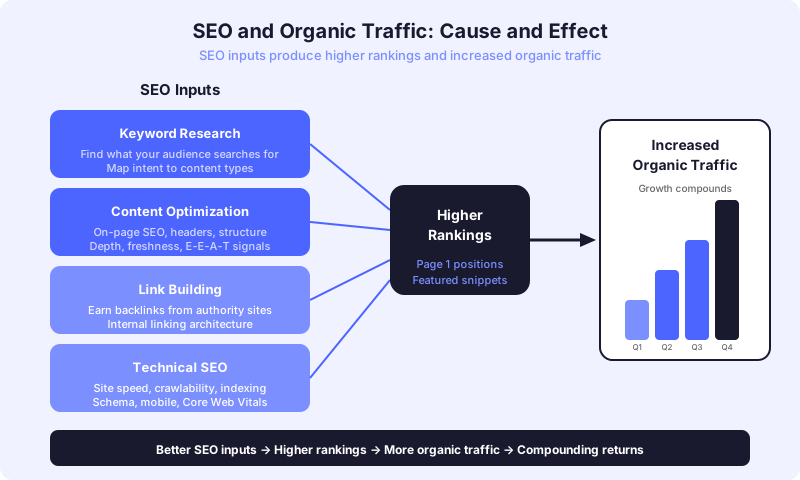
How Each SEO Component Drives Organic Traffic
Breaking SEO into its core components shows exactly how each part contributes to organic traffic.
Keyword research drives traffic targeting. Without keyword research, you are guessing which queries your audience uses. Effective keyword research identifies the specific terms people type into search engines, their search volume, and their intent. This data determines what content to create and how to optimize it.
Keyword research also reveals the distribution of opportunity. 69% of all search traffic comes from long-tail keywords with three or more words. Targeting only broad, high-volume keywords means competing for 31% of total search traffic. A comprehensive keyword strategy captures both.
On-page optimization drives relevance. Title tags, meta descriptions, heading structure, keyword placement, and content quality all signal relevance to Google. SEO content optimization techniques ensure that every page communicates its topic clearly to search engines.
The practical impact is measurable. Pages with the primary keyword in the title tag, first 100 words, and at least one H2 consistently outrank pages without these signals. On-page optimization is the most controllable SEO factor because it depends entirely on your content team's execution.
Link building drives authority. Pages ranking in position one have an average of 220 backlinks and 3.8x more backlinks than pages in positions two through ten. Each quality backlink transfers authority to your page, strengthening its ability to rank.
Link building connects SEO to organic traffic through a compound effect. More authority produces higher rankings. Higher rankings produce more visibility. More visibility produces more natural link acquisition from other sites that discover your content through search.
Technical SEO drives accessibility. 62.7% of global web traffic comes from mobile devices. Google uses mobile-first indexing, meaning your mobile experience determines your rankings. Sites with slow load times, broken mobile rendering, or crawl errors lose organic traffic not because their content is bad, but because Google cannot properly access and evaluate it.
The Compounding Effect of SEO on Organic Traffic
SEO produces compound returns that paid advertising cannot match. Here is why.
Content accumulates. Every optimized page you publish is a permanent asset that can attract organic traffic for years. A site with 100 well-optimized pages has 100 entry points from search. A site with 500 has 500. Each new page increases the total surface area of your site in search results.
Authority compounds. As your site builds backlinks and publishes more content on a topic, Google's assessment of your authority increases. Higher authority means new pages rank faster and existing pages rank higher. The 200th article on a topic ranks faster than the first because of accumulated topical authority.
Internal linking multiplies. Each new page creates opportunities to link to existing pages and receive links from them. A robust internal linking strategy means every new page strengthens the entire site's ranking potential, not just its own.
This compounding dynamic is why organic traffic growth often follows an exponential curve rather than a linear one. The first six months of SEO investment may produce modest results. Months 12-24 typically show accelerating returns as the compound effects accumulate.
How to Strengthen the SEO-to-Organic Traffic Connection
If your SEO efforts are not producing proportional organic traffic growth, one or more of the three mechanisms is underperforming.
Diagnose relevance issues. Check Google Search Console for impressions without clicks. If your pages appear in search results but users do not click, your title tags and meta descriptions may not match search intent. Rewrite them to clearly communicate the page's value.
Diagnose authority issues. Check your backlink profile in Ahrefs or Semrush. If your pages rank on page two or three but not page one, they likely need more authority. Build backlinks through digital PR, original research, and guest contributions to authoritative publications.
Diagnose technical issues. Run a site audit with Screaming Frog or Google Search Console. Fix crawl errors, redirect chains, and mobile usability issues. Improve Core Web Vitals scores on your highest-traffic pages first.
Diagnose structural issues. If your content covers relevant topics but is not organized into clusters, you are missing the topical authority signal. Organize related content into content clusters with pillar pages to create the structural reinforcement that strengthens rankings across related queries.
SEO Organic Traffic in 2026
The SEO-to-organic traffic connection is not weakening. It is expanding. In addition to traditional Google search results, SEO now influences visibility in AI Overviews, AI search platforms like ChatGPT and Perplexity, and voice search results.
AI Overviews trigger for approximately 18.57% of commercial queries. Getting cited in these AI-generated summaries requires the same fundamentals that drive traditional organic traffic: clear content structure, specific data, authoritative sourcing, and comprehensive topic coverage.
The sites investing in SEO today are building organic traffic systems that work across every search interface, current and emerging. The fundamentals compound. The surfaces multiply.
Your organic traffic growth strategy should account for both traditional and AI-powered search channels. The SEO investment that drives organic traffic from Google also positions your content for AI citation.
ClusterMagic builds the content cluster architecture and SEO strategy that turns search optimization into compounding organic traffic.
Book a strategy session to strengthen the connection between your SEO efforts and organic traffic growth.
Written by Deanna S.
Recommended Posts





.svg)