

.svg)
12 Tactics to Increase SEO Traffic in 2026 | ClusterMagic

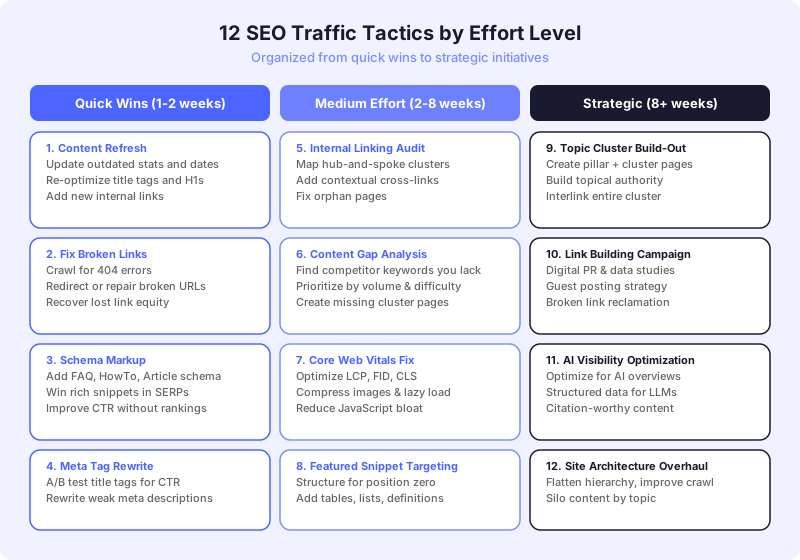
The standard advice for how to increase SEO traffic has not changed much in a decade: create good content, build backlinks, optimize for keywords. That advice is not wrong. It is just too vague to act on. What follows are twelve specific tactics, ordered by implementation effort, that produce measurable traffic gains when executed properly.
SEO still generates over 1000% more traffic than organic social media, remaining the primary acquisition channel for most websites. But the way that traffic gets captured is shifting. AI Overviews now reduce clicks by 58% for certain query types, which means the tactics that worked three years ago need updating for how search actually functions in 2026.
1. Refresh Your Top 20 Pages
Content decay is the most common reason for traffic decline. Pages that ranked well 12-18 months ago lose position as competitors publish newer, more comprehensive content.
Pull your top 20 pages by organic traffic in Google Search Console. Compare current traffic to the same period last year. Any page showing a 15%+ decline is a refresh candidate. Update statistics, add new sections covering recent developments, and remove outdated information. Backlinko's research shows that content freshness signals are increasingly weighted for informational queries.
2. Fix Internal Linking Gaps
Most sites leave 82% of internal linking opportunities untapped. That is a massive amount of authority sitting idle.
Run an internal link audit using Screaming Frog or Ahrefs Site Audit. Identify orphan pages (zero internal links pointing to them) and pillar pages receiving fewer than ten internal links. Build links from contextually relevant pages. Your internal linking strategy should connect every page to its cluster hub and to related supporting pages.
3. Target Long-Tail Keywords Your Competitors Ignore
69% of all search traffic comes from long-tail keywords. These queries have lower volume individually but higher intent and lower competition collectively.
Use Ahrefs Content Gap or Semrush Keyword Gap to find long-tail queries your competitors rank for that you do not cover. Group them into topical clusters and assign each to a new or existing page. Long-tail keyword strategy is the fastest way to capture traffic from queries that larger competitors overlook.
4. Add Schema Markup to Every Eligible Page
Rich results earn a 58% click-through rate compared to 41% for standard results. FAQ schema specifically achieves 87% CTR.
Audit every page for schema eligibility. Article pages get Article schema. FAQ sections get FAQ schema. How-to content gets HowTo schema. Product pages get Product schema. Validate all markup through Google's Rich Results Test before publishing.
5. Optimize for Featured Snippets
Featured snippets sit above position one and capture a disproportionate share of clicks. Target them by identifying queries where you rank in positions 2-10 that already trigger a featured snippet.
Structure your content to directly answer the query in 40-60 words immediately below a relevant H2 heading. Use lists, tables, or definition formats depending on the snippet type Google displays. The structural formatting matters more than the word count.
6. Improve Core Web Vitals
Pages meeting Core Web Vitals thresholds rank higher and convert better. Focus on Largest Contentful Paint (under 2.5s), First Input Delay (under 100ms), and Cumulative Layout Shift (under 0.1).
The highest-impact fixes are usually image optimization, lazy loading below-the-fold content, and reducing render-blocking JavaScript. Run PageSpeed Insights on your top 50 pages and prioritize fixes by traffic volume.
7. Build Content Clusters Instead of Random Posts
Individual blog posts compete for rankings. Content clusters compound authority across an entire topic. B2B companies publishing nine or more blog posts per month saw a 35.8% increase in yearly Google traffic, compared to 16.5% for those posting one to four times monthly.
Organize your content into hub-and-spoke clusters. Each hub covers a broad topic. Spokes target specific subtopics. Bidirectional linking between them creates authority loops that individual posts cannot match.
8. Earn Backlinks Through Digital PR
The first position on Google has an average of 220 backlinks. Pages in position one have 3.8x more backlinks than those in positions two through ten.
Digital PR and data-driven content are the most effective link acquisition methods in 2026. Publish original research, industry surveys, or data analyses that journalists and bloggers cite. One strong digital PR campaign can generate more high-quality backlinks than months of manual outreach.
9. Optimize Existing Content for Search Intent
Ranking for a keyword means nothing if your page does not match what the searcher actually wants. Pull your top 100 keywords from Search Console and check each SERP manually.
If Google shows product comparison pages and your ranking page is a definition article, you have an intent mismatch. Rewrite or restructure the page to match the dominant intent in the SERP. This single adjustment often produces ranking jumps within weeks.
10. Target AI Overview Visibility
AI Overviews now trigger for approximately 18.57% of commercial queries. Getting cited in AI Overviews requires structured, clear, concise answers backed by authoritative sourcing.
Use clear question-and-answer formatting. Include specific data points with citations. Structure content with descriptive headings that match common query patterns. The pages Google pulls into AI Overviews tend to be well-structured, factual, and concise.
11. Consolidate Thin and Duplicate Pages
Thin pages drag down your domain's overall quality score. Audit your site for pages with fewer than 300 words, pages targeting the same keyword, and pages with zero organic traffic over the past six months. Running this kind of audit efficiently requires the right tooling — the SEO audit tools comparison breaks down which platforms are best suited for content-focused teams doing site health and gap analysis.
Merge related thin pages into comprehensive resources. Redirect duplicate pages to the strongest version. Removing or consolidating low-quality pages improves crawl efficiency and concentrates authority on the pages that matter.
12. Build a Consistent Publishing Cadence
Sporadic publishing signals inconsistency to search engines. A predictable content velocity and publishing cadence builds crawl momentum and trains Google to return to your site regularly.
Set a sustainable publishing frequency based on your team's capacity. Two high-quality posts per week consistently beats ten mediocre posts per month. Quality and consistency compound. Volume without quality does not.
Prioritizing These Tactics
Not every tactic applies equally to every site. Start with tactics 1-4 (content refreshes, internal linking, long-tail keywords, schema markup) because they improve existing assets before requiring new content production.
Move to tactics 5-8 (featured snippets, Core Web Vitals, content clusters, digital PR) once your existing content is optimized. Tactics 9-12 (intent matching, AI visibility, consolidation, publishing cadence) build the long-term system that sustains growth.
If you want help building the content cluster architecture that makes these tactics compound, ClusterMagic maps the strategy so your execution has direction.
Book a free strategy call to identify which tactics will move the needle fastest for your site.
Written by Deanna S.
Recommended Posts





.svg)