

.svg)
Audience Engagement Content Strategy That Drives Real Growth | ClusterMagic

Why Audience Engagement Is an SEO Signal, Not Just a Marketing Goal
Audience engagement content sits at the intersection of SEO and content marketing in a way that many teams still underestimate. Google does not rank purely on keyword presence. Behavioral signals, how long visitors stay, whether they click through to other pages, whether they return, feed into what Google calls page experience, part of the algorithm's assessment of content quality.
A page that attracts traffic but fails to hold attention will lose rankings over time. A page that earns genuine engagement sends repeated positive signals to search engines and accumulates authority through return visits, shares, and natural links. Content engagement strategy is therefore not separate from SEO strategy. It is part of it.
This guide explains how to build content that attracts the right audience and earns their attention long enough to make an organic growth impact.
Define Your Audience Before You Define Your Topics
Content created for "everyone" rarely engages anyone deeply. The most effective audience engagement strategies start with a precise definition of who the content is actually for, what they already know, what they are trying to accomplish, and where their knowledge gaps are.
For content teams building organic traffic, this means mapping the audience by intent tier:
- Awareness-stage readers are encountering a problem or concept for the first time. They need clear definitions, context, and orientation.
- Consideration-stage readers understand the problem and are evaluating approaches. They need comparisons, frameworks, and decision criteria.
- Decision-stage readers are ready to act. They need proof, specifics, and a clear next step.
Content that serves one of these audiences well will underserve the others. The strategic move is publishing distinct content for each tier and linking between them. The Content Marketing Institute's annual research confirms that the most successful B2B content teams plan distinct assets for each stage. This tiered approach is the foundation of a well-structured blog content strategy.
What "Engaging" Actually Means in a Content Context
Engagement is often treated as a vague goal ("make it more engaging!") without a concrete definition. For practical content strategy purposes, engagement means the content holds the reader's attention long enough to deliver its full value and prompts a next action.
Specific signals that indicate high engagement:
- Time on page: Readers who stay several minutes are consuming the content fully rather than bouncing immediately
- Scroll depth: Deep scrolling signals the reader found the content worth continuing through
- Pages per session: Engaged readers follow internal links to related content
- Return visits: Readers who come back signal that the first experience was valuable enough to seek more
- Social shares and backlinks: Readers who share or cite content are explicitly endorsing its value
Each of these behaviors reinforces the content's organic performance. They are not vanity metrics. They are signals that search engines use to assess whether a page genuinely serves its readers.
Structure: The Easiest Engagement Lever You Are Probably Underusing
Most engagement problems are structure problems. Readers land on a page and cannot quickly assess whether it will answer their question. They leave. The content may be excellent, but poor structure made it invisible.
High-engagement content structure follows a simple principle: make the value visible immediately. The opening must answer "what will I get from this?" within the first two paragraphs. Headers should be specific enough to function as a table of contents. The reader should be able to scan the page and understand the content's full argument without reading every word.
This structure also benefits SEO. Clear, specific H2s and H3s give search engines explicit signals about the content's topical scope. Structured content earns featured snippets and People Also Ask placements more reliably than dense, unformatted prose.
Short paragraphs help. No block of text should force a reader to hold more than four sentences in working memory before reaching a natural pause. Lists and bolded key phrases create visual anchors that keep attention moving forward rather than drifting away.
Content Formats That Drive Higher Audience Engagement
Not all formats earn equal engagement. Research from Demand Metric consistently shows that interactive content earns 2 to 3 times more engagement than static equivalents, and readers spend an average of 13 minutes with interactive content versus 8.5 minutes with static formats.
For most content teams building organic search traffic, fully interactive formats (quizzes, calculators, assessments) require development resources that are not always available. But the principles of interactivity can be applied to static content:
- Practical frameworks with named steps or tiers give readers something to apply immediately, which creates a sense of participation
- Self-assessment questions embedded in text prompt readers to reflect rather than just consume
- Comparison tables let readers actively evaluate options rather than passively absorbing descriptions
- Annotated examples show the principle in action, which is more engaging than explanation alone
For a broader view of how these content formats connect to search performance, the organic traffic growth guide covers format-specific ranking factors in detail.
Building Topical Depth to Earn Audience Loyalty
A single highly engaging post earns a one-time visit. A cluster of deeply connected content on a topic earns return visits and newsletter subscribers. The distinction between a site that spikes in traffic and one that builds sustained organic growth often comes down to topical depth.
Proven audience engagement tactics help you maximize the impact of that depth once it exists. Topical depth means covering every meaningful angle of a subject your audience cares about. If your audience is content teams at B2B SaaS companies, topical depth means covering content strategy, brief writing, production workflows, distribution, performance measurement, and content repurposing, all interconnected through strong internal linking.
Each post in the cluster answers a specific question. Together, the cluster answers every question a reader in that audience might have. When readers find that your site reliably has the answer, they bookmark it, return, subscribe, and eventually become customers or referrers.
Content clusters are the structural mechanism for building this topical depth at scale. The pillar page covers the broad topic. Cluster posts cover subtopics in detail. Internal links connect them into a coherent knowledge base rather than a collection of isolated posts.
Matching Content Cadence to Audience Expectations
Engagement drops when content appears irregularly. Audiences that enjoyed one post return to find nothing new for weeks, then stop returning. Search engines interpret inconsistent publishing as a signal of lower site health.
Sustainable engagement requires a publishing cadence the team can maintain, not a sprint pace that burns out after two months. A consistent schedule of two high-quality posts per week will outperform a burst of ten posts followed by silence.
The right cadence depends on team capacity and audience behavior. B2B audiences tend to engage well with a weekly or biweekly schedule on in-depth topics. Consumer audiences may engage more with higher-frequency, shorter content. Testing both formats and tracking return visit rates over 60 to 90 days will show which cadence best fits your audience.
For teams managing content production across multiple writers or freelancers, a structured content creation process removes the coordination bottlenecks that cause inconsistent publishing.
Measuring Engagement to Improve Future Content
An audience engagement strategy that does not measure outcomes is a series of experiments with no data. Measuring engagement turns individual posts into a feedback loop that improves every subsequent piece.
Set up tracking for:
- Average scroll depth per post (GA4's engagement rate metric provides this natively)
- Average engagement time per session, segmented by content category
- Pages per session for organic traffic (a sign of how well internal links drive further reading)
- Return visitor rate for blog traffic specifically
Review these metrics monthly at minimum. The content performance metrics guide covers which engagement signals matter most and how to interpret them in context. Identify the top quartile of posts by engagement time and scroll depth. Analyze what they have in common: format, topic, structure, length, how they handle the opening. Apply those patterns to new content.
Identify the bottom quartile as well. Posts with high traffic but low engagement signal keyword-traffic mismatch: the content attracted visitors who wanted something different. Either update the content to better match search intent or restructure it to serve the audience that actually arrives.
Connecting Engagement to Organic Growth
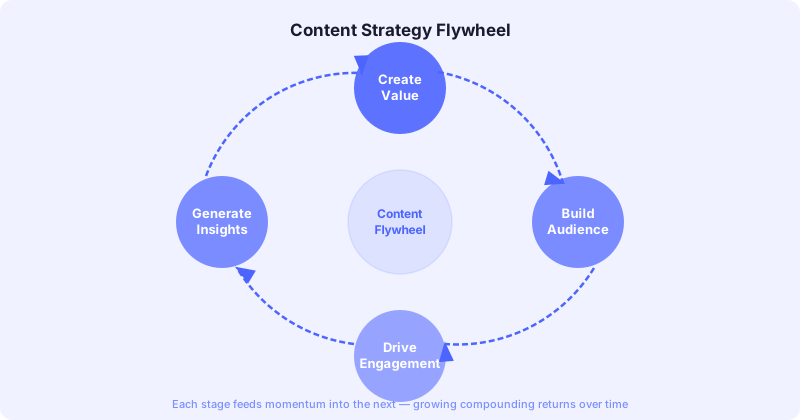
Audience engagement content strategy produces SEO results through two compounding mechanisms. First, high-engagement behavioral signals improve individual page rankings over time. Second, engaged audiences amplify content through sharing, linking, and direct traffic, which strengthens domain authority overall.
The connection between these mechanisms and measurable organic growth becomes clearer when content is structured around coherent clusters rather than isolated posts. A reader who engages deeply with one cluster post is likely to follow internal links to others, extending session time and increasing pages-per-session metrics across the cluster.
Book a walkthrough to see how ClusterMagic maps topic clusters to audience engagement patterns, identifying where your content is earning attention and where it is losing it.
Recommended Posts





.svg)