

.svg)
How to Choose a B2B Content Marketing Agency (2026 Buyer's Guide) | ClusterMagic

How to Choose a B2B Content Marketing Agency (2026 Buyer's Guide)
Hiring a B2B content marketing agency is one of the bigger bets a marketing team makes. Done right, it compounds: a strong content program builds organic authority, fills the top of funnel, and shortens sales cycles over time. Done wrong, it burns budget on content nobody reads, in a format that doesn't rank, written by writers who don't understand the industry.
This guide gives you a clear framework for evaluating agencies before you sign anything. It covers what separates B2B content specialists from general agencies, the three main models, red flags to walk away from, and the questions worth asking on every sales call.
What a B2B Content Marketing Agency Actually Does
A B2B content marketing agency produces and distributes content that supports a business-to-business sales cycle. That sounds simple, but it's distinct from what most general creative or brand agencies do. B2B content lives at the intersection of SEO, demand generation, and buyer education. The audience is often skeptical, technically informed, and comparing multiple vendors.
B2B content has to do two things at once: rank well enough to be found, and be substantive enough to be trusted. General creative agencies are often strong on the second but weak on the first. Pure SEO shops tend to do the opposite. The agencies worth hiring can show you how they handle both.
A real B2B content shop will have documented processes for keyword research, topic clustering, content briefing, and performance measurement. They'll understand the difference between informational content (attracts top-of-funnel traffic), commercial content (captures buyers evaluating options), and sales enablement content (helps close deals). If those distinctions don't come up early in conversation, that's a signal worth noting.
A strong agency should also be able to speak fluently about what an SEO content strategy looks like for your specific market and buying cycle.
The Three Agency Models
Most B2B content agencies fall into one of three models. Knowing which type you're evaluating changes how you assess fit.
Full-service agencies handle strategy, production, distribution, and reporting. They assign account managers, content strategists, writers, editors, and SEO specialists to your account. This is the most expensive model and works best for teams that don't have in-house content expertise and need the agency to function as a full content department.
Content-only agencies take a strategy you've already defined and execute against it. They produce briefs, assign writers, manage editorial review, and deliver finished content. They typically don't own keyword research or performance reporting. This model works well if you have a content strategist or marketing director who can own the strategy layer.
Strategy-only agencies do the research, build the cluster architecture, and hand you a roadmap. They may help with the first few pieces to demonstrate the approach, but production stays in-house or with a separate vendor. This is the right choice if you have a content team with capacity but no one who knows how to build an SEO-driven content program from scratch.
Understanding which model you need before you start talking to agencies saves a significant amount of time. Most agencies will try to sell you the most expensive version of what they offer. Know what you actually need. If you're still working out what a strong B2B content marketing strategy looks like for your company, a B2B content marketing plan template gives you a starting framework. Get that clarity before you hire.
What Strong Agencies Show You Before You Sign
A good B2B content marketing agency shouldn't ask you to trust their reputation alone. The strongest agencies make the sales process educational. They show you how they think, not just what they've produced.
Here's what to look for before committing to a contract:
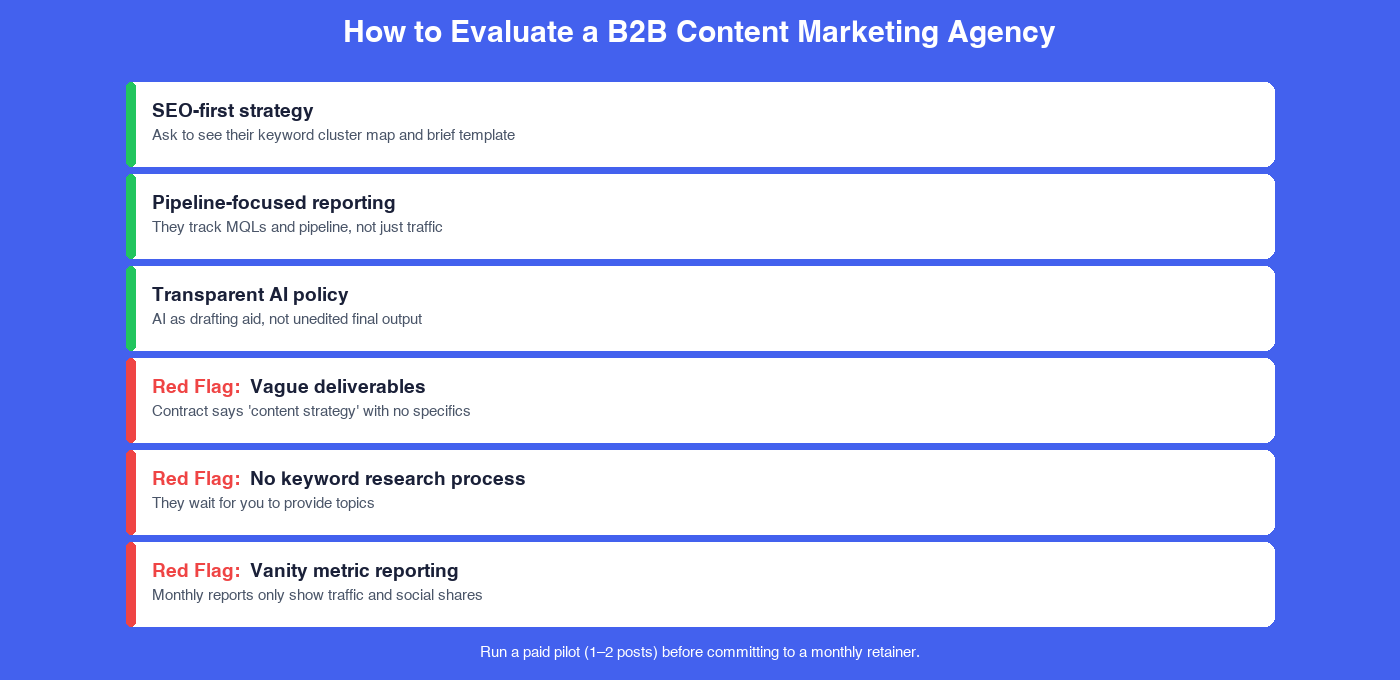
- Sample content briefs. A brief reveals how an agency approaches a piece of content. It should show keyword targeting, search intent, required sections, internal and external linking guidance, and a clear content goal. A brief that's just a title and a word count is a red flag.
- Cluster maps or topic architecture examples. Strong agencies organize content into clusters, not individual posts. If they can show you how they've structured a topic territory for a comparable client, you're looking at a mature process.
- Case studies with pipeline or revenue data. Traffic metrics are vanity metrics unless they tie to business outcomes. Look for case studies that connect content programs to lead volume, pipeline, or customer acquisition. Clutch and G2 both publish verified client reviews that go beyond the agency's own selected testimonials.
- Writer samples in your industry. B2B content for cybersecurity reads differently from B2B content for HR software. Ask to see writing samples from a vertical close to yours. Generic samples from a range of industries signal a generalist team.
If an agency can't or won't provide these things at the proposal stage, the relationship won't get more transparent after you sign.
Red Flags to Avoid
Most agencies are good at selling. The red flags aren't obvious during a polished 45-minute demo. Here are the ones that show up repeatedly in post-mortem conversations with companies that hired the wrong agency.
Vague deliverables. "We'll handle your content strategy" without a list of what that includes is not a deliverable. Push for specifics: how many posts per month, what formats, who writes them, what's the editorial process, how are briefs produced. If the answer is still vague after follow-up, the contract will be vague too.
No documented keyword research process. Strong agencies can walk you through how they identify target keywords, assess competition, map intent, and assign terms to specific content. If the answer is "we do keyword research" without detail, the research is probably surface-level.
"We handle everything" without specifics. Full-service is a real model, but it should come with a clear org chart of who does what on your account. Who is the strategist? Who writes? What's the approval process? Vagueness here usually means the work is done by generalist contractors with no real oversight.
No mention of topical authority or cluster structure. Publishing individual posts optimized for individual keywords is a 2018 SEO strategy. Agencies still pitching "20 blog posts per month targeting these keywords" without discussing content clusters and pillar pages are not current.
Guaranteed rankings. No ethical agency guarantees specific ranking positions. Search engines don't work that way. An agency promising page-one rankings in 90 days for competitive terms is either misleading you or planning to use tactics that will eventually cause problems.
Evaluating Fit: Industry Knowledge, Content Quality, and Reporting
Beyond process, fit matters. Three dimensions are worth evaluating separately.
Industry knowledge is often the differentiator between content that earns trust from a B2B buyer and content that reads like it was written by someone who skimmed the industry Wikipedia page. For agencies serving the technology sector specifically, the B2B tech content marketing guide covers the unique requirements that separate tech-savvy agencies from generalists. Ask which verticals the agency has worked in and push for specifics. Ask to speak to a writer who has worked on accounts in your space. The Content Marketing Institute's annual B2B report consistently shows that audience-relevance outperforms volume as a driver of content effectiveness.
Content quality is subjective but not unevaluable. Read five to ten pieces from their portfolio. Are they skimmable but substantive? Do they take clear positions, or hedge everything? Do they link to credible sources? Do they feel like they were written by someone who actually knows the subject? Weak quality often shows up as vague claims, excessive passive voice, and no concrete examples.
Reporting transparency is where many agencies fall short. Ask to see a sample monthly report. It should show organic traffic trends, keyword rankings, content performance by post, and some interpretation of what the data means. A report that's just a screenshot of Google Analytics with no context isn't a report. The HubSpot State of Marketing Report is a useful benchmark for what B2B content programs should be measuring.
Retainer vs. Project Pricing
Most B2B content agencies offer both retainer and project-based engagements. The pricing model tells you something about how the agency prioritizes its own work.
Retainers align the agency's incentives with long-term results. They have a reason to build a compounding content program because they stay on to see it work. Retainer pricing also tends to be more efficient per piece of content because the agency doesn't re-learn your brand with every engagement. The downside is that retainers can become comfortable for agencies. After month six, ask hard questions about whether velocity and quality have held up.
Project pricing works for one-time needs: a pillar page, a cluster build, a content audit. It's useful for testing a new agency before committing to a retainer. The risk is that project-based work often optimizes for delivery, not performance. The agency ships the work and moves on. Nobody is accountable for whether it ranks.
If you're considering an agency for an ongoing program, a paid pilot before a retainer is almost always worth it. A well-defined pilot, covering two to three months and a specific cluster, tells you more than any sales call.
Questions to Ask in the Sales Call
Go into every agency call with a written list. These questions separate agencies with real processes from those with polished pitches:
- Walk me through how you'd approach keyword research for our topic area. What tools do you use, and how do you prioritize terms?
- How do you structure a content cluster? Can you show me an example from a comparable client?
- Who writes content on our account? Are they employees, contractors, or freelancers? What's the editorial review process?
- What does a content brief look like on your accounts? Can you share a sample?
- How do you measure success at 90 days? At 12 months?
- What does a monthly report include, and who walks us through it?
- What's the escalation process if content quality falls short?
- Have you worked with companies in our industry or at our deal size?
Pay attention to how the agency handles questions they don't have clean answers to. Confidence without substance is a red flag. Honest uncertainty with a clear process for working through it is a good sign. If you want to get started with a topic-cluster-focused alternative before committing to an agency retainer, it's worth seeing what a structured content program looks like in practice.
How to Run a Paid Pilot
A paid pilot is the single best way to de-risk an agency hire. It works like this:
- Define a specific scope: one topic cluster, two to three months, three to five posts.
- Agree on deliverables in writing: cluster architecture, content briefs, finished posts, an internal linking map.
- Set measurable success criteria: posts indexed, target keywords in top 50 within 60 days, content quality meeting your editorial standards.
- At the end of the pilot, evaluate against those criteria before discussing a retainer.
A good agency will welcome the structure. It gives them a chance to demonstrate their process in a low-stakes context. An agency that pushes back on defined success criteria is signaling that they prefer ambiguity.
If you're comparing an agency against alternatives like managed content subscription services, a pilot also gives you an apples-to-apples comparison for quality, turnaround time, and editorial fit. ClusterMagic is one option in that category — a topic-cluster-focused service that handles keyword research, brief writing, content production, and publishing for a flat monthly fee.
Building a B2B content program takes time, and the agency you hire becomes a significant partner in that work. Taking an extra three weeks to evaluate properly is almost always worth it. The cost of a poor hire compounds just as much as the cost of a great one.
Recommended Posts





.svg)