

.svg)
Content-Led B2B Marketing: How to Build a Growth Engine That Compounds | ClusterMagic

B2B buyers complete the majority of their research before ever speaking with a sales team. The brands that show up during that research phase with useful, specific content are the ones that make the shortlist. Content-led B2B marketing is the strategy of making content the primary driver of pipeline, not a support function that produces occasional blog posts and leaves them to sit.
The difference between a B2B company that treats content as a checkbox and one that treats it as a growth engine comes down to architecture. A content-led approach means every piece of content serves a defined role in the buyer journey, connects to other content on the site, and is built to compound in value through organic search.
This guide covers how to build that engine from scratch, including the strategy framework, distribution model, and measurement approach that separates content-led growth from content-as-busywork.
What Content-Led B2B Marketing Actually Means
Content-led growth is a term that gets thrown around loosely. In practice, it means content is the primary acquisition and nurture channel, not an accessory to paid campaigns or sales outreach. The content itself does the work of attracting prospects, educating them, and moving them toward a buying decision.
This is distinct from content marketing as most B2B companies practice it. Traditional content marketing often produces assets that support other channels: a whitepaper for a gated landing page, a blog post to share on social media, an email newsletter recap. Content-led growth flips that. Content is the channel. Organic search, not paid distribution, is the primary traffic mechanism.
The economics are compelling. According to research from the Content Marketing Institute, B2B companies that prioritize content marketing generate three times more leads per dollar spent than paid search. The catch is that content compounds slowly. The payoff comes at month 8, not month 2. Teams that understand that timeline invest accordingly.
The B2B Content-Led Growth Framework
Map Content to the Buyer Journey, Not to a Calendar
Most B2B content calendars are organized by publishing frequency. "We need two posts per week" is a schedule, not a strategy. Content-led B2B marketing requires mapping every piece to a specific stage of the buyer journey and a specific search intent.
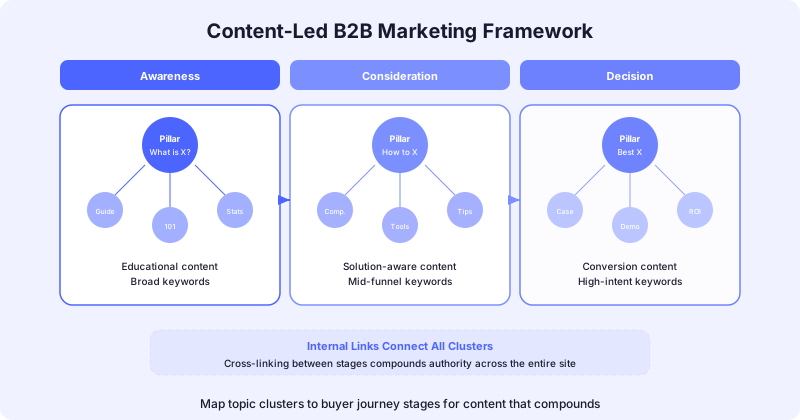
The stages that matter for B2B:
- Problem-aware: The buyer knows they have a challenge but has not started evaluating solutions. Content here is educational: guides, explainers, benchmarks. Keywords tend to be informational ("what is topical authority," "how to improve organic rankings").
- Solution-aware: The buyer understands the category of solution they need and is comparing approaches. Content here is evaluative: frameworks, comparisons, playbooks. Keywords are commercial ("best B2B content marketing strategy," "content cluster tools").
- Decision-stage: The buyer is evaluating specific vendors. Content here builds trust: case studies, service pages, pricing comparisons.
Each stage requires different content formats, different keyword targets, and different calls to action. A content-led strategy plans all three stages before publishing anything.
Build Topic Clusters Around Buyer Problems
Isolated blog posts do not compound. Topic clusters do. A cluster is a set of interconnected pages covering one subject from multiple angles, linked together through a central pillar page. When a B2B company builds clusters around the problems their buyers actually have, the entire cluster earns more search visibility as each new piece is added.
For a B2B SaaS company selling marketing analytics, the clusters might be:
- Attribution modeling (pillar + 8 supporting posts)
- Marketing ROI measurement (pillar + 6 supporting posts)
- Data integration for marketing teams (pillar + 5 supporting posts)
Each cluster maps to a real problem the buyer faces. Each supporting post answers a specific question within that problem space. The content cluster model is the structural backbone of content-led growth.
Prioritize Topics by Revenue Potential, Not Search Volume
A keyword with 5,000 monthly searches and zero connection to your product is worth less than a keyword with 200 searches that your ideal buyer types right before starting a vendor evaluation. Content-led B2B marketing prioritizes topics by proximity to revenue, not by raw traffic potential.
Score each potential topic on three dimensions:
- Search volume: Is there enough demand to justify the content investment?
- Buyer relevance: Does this topic attract your ideal customer profile?
- Product alignment: Can your product or service be naturally referenced as a solution?
Topics that score high on all three go first. Topics with high volume but low relevance get deprioritized or skipped entirely. This is the discipline that separates content-led growth from content-led busywork.
Distribution: Let SEO Do the Heavy Lifting
Organic Search as the Primary Channel
Paid distribution has its place, but content-led growth depends on organic search as the scalable, compounding channel. A blog post that ranks on page one for a relevant query generates traffic for years without ongoing spend. That same post promoted through paid social generates traffic for as long as the budget lasts.
Building for organic search means:
- Every post targets a specific keyword with validated search volume
- On-page optimization follows established SEO content strategy principles
- Internal linking connects each new post to the broader cluster
- Technical SEO (page speed, crawlability, structured data) supports the content
The goal is a self-sustaining traffic engine. Once a cluster reaches critical mass (typically 8 to 12 published pieces with strong internal linking), it begins pulling in traffic from keywords the individual posts never explicitly targeted.
LinkedIn as the Amplification Layer
For B2B specifically, LinkedIn serves as a distribution accelerant. Sharing content organically on LinkedIn will not replace SEO, but it generates early engagement signals, drives initial traffic to new posts, and builds awareness among a professional audience.
The effective approach is not to dump links. Summarize the post's core insight in a native LinkedIn post, add a few lines of context, and link to the full article. LinkedIn's algorithm documentation rewards posts that generate conversation, not posts that immediately push users off-platform.
Email for Nurturing, Not for Acquisition
Email is the best channel for moving an already-engaged prospect through the buyer journey. It is a poor channel for top-of-funnel acquisition. In a content-led model, email distributes content to people who have already demonstrated interest, guiding them from problem-aware to solution-aware to decision-ready.
Segment your email list by the topics each subscriber has engaged with. Someone who read three posts about content marketing ROI is in a different stage than someone who read one introductory post about SEO basics. Send them different content accordingly.
Content Production: Quality Over Cadence
Set a Sustainable Publishing Pace
One of the fastest ways to kill a content-led strategy is to set an aggressive publishing schedule that forces quality compromises. Two well-researched, thoroughly written posts per week will outperform five thin ones over any time horizon longer than three months.
B2B buyers are evaluating your expertise through your content. A shallow post that restates what the first five search results say does not build trust. A post that adds original analysis, specific data, or a distinct framework does. The content creation process matters as much as the output.
Write for Depth, Edit for Clarity
B2B content fails in two predictable ways. Either it is surface-level and says nothing the reader could not find in a competitor's post, or it is dense and technical to the point of being unreadable. The solution is to write with subject matter depth and then edit ruthlessly for clarity.
Every section should pass a simple test: would someone who manages this function at a mid-market company find this specific and actionable? If the answer is no, the section needs more detail or should be cut. B2B buyers do not need more content. They need content that respects their intelligence and their time.
Include Product Context Without Forcing It
Content-led growth only works if the content occasionally connects to what you sell. The mistake most B2B companies make is either avoiding product mentions entirely (missing conversion opportunities) or forcing them into every paragraph (destroying trust).
The natural approach: when your product or service genuinely solves the problem being discussed, mention it. When it does not, do not. A post about building a content strategy can naturally reference a content planning tool. A post about email subject line testing probably cannot. Let the topic guide the product integration.
Measuring Content-Led Growth
Track Leading Indicators Monthly, Revenue Quarterly
Content compounds slowly. Measuring ROI monthly will make the strategy look like a failure for the first two quarters. Instead, track leading indicators monthly and tie them to revenue impact quarterly.
Monthly leading indicators:
- Organic traffic growth (by cluster, not just site-wide)
- Keywords ranking in top 10 (total and per cluster)
- Pages indexed and ranking
- Email subscribers from content
Quarterly revenue indicators:
- Pipeline influenced by content touchpoints
- Deals where the buyer engaged with 3+ content pieces before converting
- Customer acquisition cost compared to paid channels
- Content-attributed revenue (first-touch and multi-touch models)
Attribution Is Imperfect. Measure Anyway.
B2B sales cycles are long and involve multiple stakeholders. Attributing a deal to a single blog post is almost never accurate. But not measuring content's revenue contribution gives leadership no reason to keep investing.
Use a multi-touch attribution model that gives partial credit to every content touchpoint in a buyer's journey. HubSpot's attribution reporting guide covers how to set this up. Even imperfect attribution is better than none, because it reveals which topics and clusters generate the most downstream revenue.
Common Mistakes in Content-Led B2B Marketing
Publishing without a cluster structure. Random posts on disconnected topics do not compound. Build clusters first, then fill them.
Optimizing for volume instead of depth. Publishing 20 posts per month means nothing if none of them rank. Fewer, stronger posts always win in B2B.
Ignoring the middle of the funnel. Most B2B content teams over-invest in awareness content and under-invest in solution-aware and decision-stage content. The mid-funnel is where deals are influenced.
Gating everything. Gated content creates friction. Ungated content builds trust and earns organic rankings. Gate sparingly, and only for genuinely high-value assets that justify the email exchange.
Not connecting content to sales. The sales team should know what content exists and when to share it. A content library that sales never uses is a missed multiplier.
Getting Started With Content-Led Growth
The starting point is not more content. It is a plan. Map your buyer journey, identify three to five topic clusters aligned with real buyer problems, validate keyword opportunities using a content gap analysis, and start building one cluster at a time.
Most B2B companies that commit to content-led marketing see meaningful pipeline impact within six to nine months. The ones that see it fastest are the ones that build with structure from day one.
Want to see what a cluster-based content plan looks like for your B2B company? Book a strategy session and we will map out your first three clusters with keyword data and revenue projections.
Recommended Posts





.svg)