

.svg)
Content Marketing Strategy Frameworks: Which One Fits Your Team | ClusterMagic

The Framework Problem Most Teams Don't Know They Have
Content marketing frameworks get referenced constantly in strategy decks and blog posts. But most teams that claim to follow one haven't thought carefully about whether that framework matches their situation. They adopted the first model they read about and built their program around it.
The result is a mismatch between the framework's logic and the team's actual goals. A content marketing strategy framework isn't a universal template. Each model makes specific assumptions about your audience, your resources, and what success looks like. Choosing the wrong one doesn't just slow you down. It can send your entire content program in the wrong direction.
This post compares the most widely used content strategy frameworks, breaks down what each one is actually designed to do, and explains how to pick the right one for your team.
Framework 1: The Pillar-and-Cluster Model
The pillar-and-cluster model is the dominant content strategy framework for SEO-focused programs. It organizes content around a broad topic (the pillar page) and a set of related subtopics (the cluster pages), with internal links connecting all of them.
This framework is built for topical authority. The goal is to signal to search engines that your site covers a subject comprehensively, not just in passing. A pillar page on "email marketing" supported by 10 cluster posts on segmentation, deliverability, subject lines, and automation tells Google that your site is a genuine resource on the topic.
Where it excels: SEO-first programs, B2B companies building organic search as a primary acquisition channel, teams that already have some content and want to organize it into a coherent structure.
Where it struggles: Programs that rely heavily on social distribution rather than search, or teams that can't sustain the publishing volume needed to build out full clusters.
The content clusters and pillar pages guide covers the mechanics of building this structure, including how to identify which topics deserve a pillar and how to map subtopics to cluster posts.
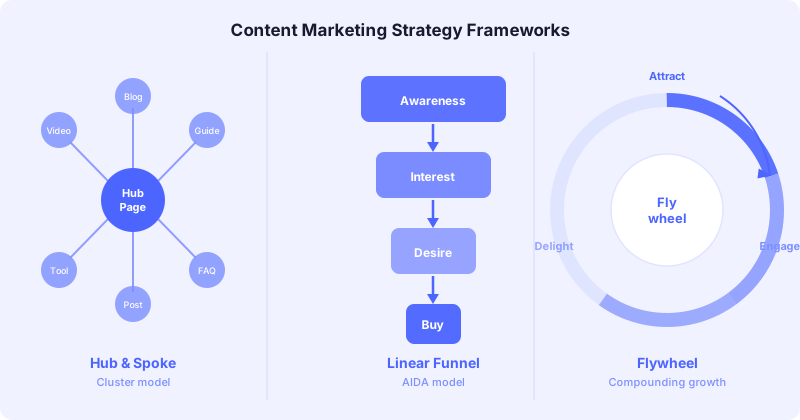
Framework 2: The Hub-and-Spoke Model
The hub-and-spoke model is architecturally similar to pillar-and-cluster but has a different emphasis. The hub is a central content asset, often a long guide, a research report, or an interactive tool, and the spokes are supporting content formats that drive traffic back to that hub.
Unlike the pillar-and-cluster model, hub-and-spoke is as much about distribution as it is about SEO. The hub is typically designed to earn backlinks, press coverage, or social sharing. The spoke content repurposes or amplifies the hub across different channels and formats.
Hub-and-spoke works best for teams that have strong promotional and distribution capabilities. If your team can get a research report featured in industry newsletters, or turn a comprehensive guide into a webinar, a podcast series, and a slate of social posts, this model compounds your investment in each major content asset.
Where it excels: Teams with PR or community leverage, brands that produce original data or research, programs where a few flagship assets drive most of the value.
Where it struggles: Teams without strong distribution channels, or programs where SEO is the primary goal and link-earning isn't a realistic near-term outcome.
Framework 3: The Funnel-Stage Model (TOFU, MOFU, BOFU)
The funnel-stage model organizes content by where the reader is in their buying journey. Top-of-funnel (TOFU) content attracts people who are just becoming aware of a problem. Middle-of-funnel (MOFU) content helps people who are evaluating solutions. Bottom-of-funnel (BOFU) content speaks to people who are close to making a decision.
This framework is the most commonly taught model in demand generation and content marketing courses. Its main advantage is clarity: every piece of content has an explicit role, and the team understands who each piece is meant to reach and what action it's meant to drive.
The funnel model's weakness is that it can produce content silos. TOFU, MOFU, and BOFU content are often treated as separate programs with separate goals, and the connections between them get neglected. A reader who finds your TOFU blog post has no clear path to your MOFU comparison guide unless the internal linking structure is deliberately designed to guide them there.
Where it excels: Teams with defined demand generation goals, programs where content is closely integrated with sales, companies that need to justify content investment in terms of pipeline contribution.
Where it struggles: SEO-first programs where topical authority is the goal, content teams that operate independently from sales, and situations where organic traffic is the primary metric.
Framework 4: The Buyer Journey Model
The buyer journey model is a variation on the funnel framework but uses the buyer's perspective rather than the marketer's. Instead of TOFU, MOFU, BOFU, it maps to awareness, consideration, and decision, and each stage is defined by what the buyer is thinking and doing rather than where they sit in your pipeline.
The difference matters more than it sounds. A funnel model asks "what stage is this person at?" A buyer journey model asks "what question is this person trying to answer right now?" That shift in framing tends to produce more genuinely useful content because the writer is thinking about the reader's need rather than the marketer's pipeline stage.
The buyer journey model pairs well with topical authority-building because it naturally pushes you toward answering real questions rather than producing content that serves internal marketing goals. Topical authority explains why covering the full range of buyer questions, not just the ones closest to conversion, is what actually builds search authority over time.
Where it excels: Brands with a strong educational or consultative selling motion, companies where trust-building is a key part of the customer acquisition process, and teams that want content to feel genuinely useful rather than promotional.
Where it struggles: Programs that need tight integration with pipeline metrics, or teams that need a simple, easily communicated framework for stakeholder alignment. Measuring which framework drives the best returns requires a clear content strategy ROI measurement system.
Framework 5: The Topic Ownership Model
The topic ownership model is the newest of the major content strategy frameworks, and it's the one most aligned with how search works in 2026. The goal is to own an entire topic area comprehensively enough that your site becomes the default resource when people (and AI systems) look for information on that subject.
Unlike the pillar-and-cluster model, which focuses on content architecture, the topic ownership model is more about breadth and depth of coverage. It asks: "Is there any relevant question about this topic that our site doesn't answer well?" If the answer is yes, that's a gap to fill.
Topic ownership frameworks drive toward topical authority at the domain level, not just the cluster level. They're particularly well-suited to programs competing in categories where large authoritative sites already dominate and a narrow cluster-based approach isn't enough to break through.
For B2B companies specifically, the b2b content marketing strategy guide covers how to adapt these frameworks for longer sales cycles and buying committees where multiple stakeholders need to be reached with different types of content.
How to Choose the Right Framework
The honest answer is that most mature content programs use elements of multiple frameworks. But you need a primary framework to make decisions when priorities conflict.
Use the pillar-and-cluster model if SEO is your primary acquisition channel and you want a clear structure for organizing your content investment over time.
Use hub-and-spoke if you have strong distribution capabilities and want to maximize the return on a small number of high-effort content assets.
Use the funnel-stage model if your content is tightly integrated with a demand generation program and you need to demonstrate pipeline contribution.
Use the buyer journey model if you're in an early-stage program where building trust with a skeptical audience is more important than short-term conversion.
Use the topic ownership model if you're in a competitive category and need to build enough breadth and depth to establish genuine authority. The integrated content strategy guide covers how to combine elements from multiple frameworks into a single operational system.
The blog content strategy guide shows how to operationalize whichever framework you choose at the blog level, including how to translate a strategic model into a practical publishing plan.
Applying Your Framework With ClusterMagic
The content strategy framework guide provides the operational layer that bridges the gap between model selection and execution. The gap between choosing a framework and executing it is where most content programs stall. ClusterMagic maps your existing content against any of these frameworks, identifies where your coverage is thin, and generates the cluster or spoke content needed to fill the gaps.
If you're trying to decide which framework fits your program or want to see how your current content maps to one, book a walkthrough and we'll run the analysis together.
Sources:
Recommended Posts





.svg)